Intertwined Roots

Update from Roots of Tomorrow – June 2025.
The Roots of Tomorrow project, which we are carrying out in Uganda with the support of our partners at Insieme si può..., is progressing as planned. After the initial activities launched in recent months, the six participating schools are continuing their journey with school-based agriculture.
After preparing the soil and planting, the gardens are now starting to give something back. Not just vegetables and legumes, but also new ways of working together, solving practical problems, and making the most of available resources — both in the classroom and outside.
The second training module has now been completed. Trainers, supported by interns from Busitema University and local teachers, have closely followed the progress of the gardens. Meanwhile, the children have been actively involved, learning skills they can also use at home.
More than the numbers, it’s the stories that matter. Here are three, to give a sense of what’s really happening on the ground.
Loputuk Primary School
When a cowpea buys a notebook
At Loputuk, teacher Josephine planted cowpeas with her class. Once harvested, they were sold. The money was used to buy notebooks and textbooks. A simple gesture that shows how even a small school garden can become a concrete resource for the school.
Musas Primary School
Caroline’s vertical garden
Teacher Caroline had very little space to work with. So she filled burlap sacks with soil and created a vertical garden. In each sack, she planted onions and tomatoes. The system works, uses little water, and is easy to replicate. It’s a practical experiment, well adapted to the local context.
Kodonyo Primary School
Ash, charcoal, and Joseph’s idea
Joseph comes from a farming family. He had seen ash used to keep pests away from crops. Thanks to the training, he started enriching the soil with a mixture of crushed charcoal, sand, and manure. It’s a blend of traditional knowledge and new techniques — and it’s already showing results.
Neem: a useful tree
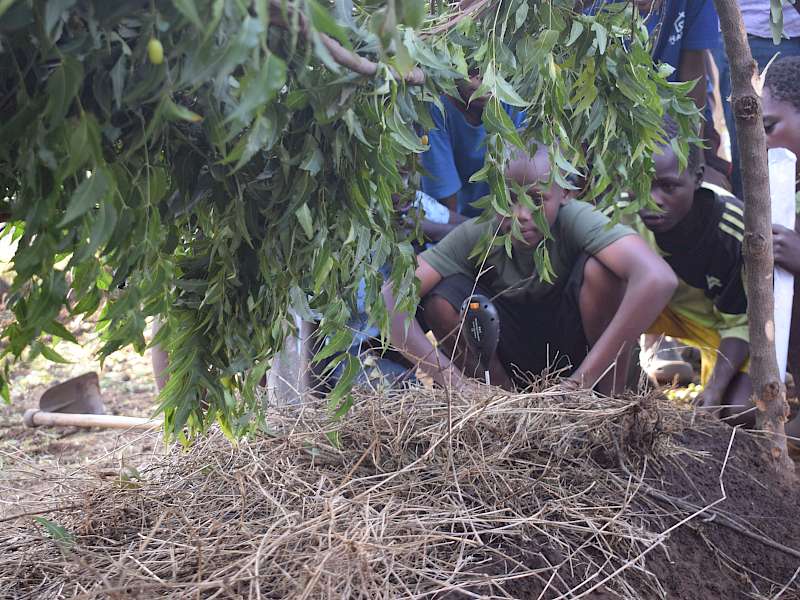
Neem was widely used throughout the activities. Known for its natural pesticide properties, neem leaves are used to prepare organic insect repellents that are effective and safe for the environment. It’s a local, accessible and sustainable method.
Those who teach, keep learning
Many of the interns currently supporting the gardens were once beneficiaries of our scholarship programme. Today, they’re giving back to their communities by putting what they’ve learned into practice — and continuing to learn through hands-on experience.
The third training module will start soon. It will focus on harvesting, post-harvest management, seed saving, and food education. In the meantime, we’re continuing to collect weekly data from the six school gardens to better understand what works and adjust accordingly.
The project is moving forward steadily. The schools are working, learning, and taking care of what they’ve begun to grow.
We’ll keep following their journey — and sharing their stories.
